
Nouvelles
Contactez-nous dès maintenantHow PVC Profiles Improve Pre-Hung Door Yield
-
 auteur
- 28 août 2026


A pre-hung door line loses yield in small, ordinary moments: one bowed jamb is rejected, one cracked edge needs trimming, one profile does not sit cleanly in the fixture. Those minutes look harmless until they repeat across a shift. For door manufacturers, the practical question is not whether PVC can replace wood in theory, but whether factory-precise PVC profiles can make every cut, corner, and assembly station more predictable.
Yield Loss Starts Before Final Assembly
Door-frame waste often begins before a frame reaches the final squaring station. Natural wood can bring knots, splits, moisture movement, or bowing into a dimension-sensitive process. Operators then spend time sorting material, adjusting cuts, or setting aside parts that no longer match the planned assembly sequence.
Pre-hung production is especially sensitive because the frame is not a loose trim item. The jamb must support machining, hardware preparation, trim coordination, and installation fit. A small material defect can move through several stations before anyone sees the full cost.
Scrap is only the visible part
Rejected pieces are easy to count, but yield loss also hides inside slowed throughput. A worker may stop to check a profile, recut a rail, clean up a rough edge, or search for a straighter length. Those pauses reduce finished-frame output even when no scrap is recorded.
Variation creates extra handling
Variation also changes how people work around fixtures. When one piece needs pressure to sit flat and another slips into place, assembly rhythm becomes uneven. The result is a steady drag on consistency, training, and shift-level confidence.
What Factory-Precise PVC Changes
UN PVC door frame profile gives the production team a more controlled starting point because the profile is extruded to a repeatable shape rather than selected from naturally variable stock. The yield benefit comes from that repeatability: the same edge, groove, surface, and depth can move through cutting and machining with fewer surprises.
The material choice does not remove the need for good tooling. Saw blades, hold-down pressure, CNC programs, and measuring checks still matter. A PVC profile simply makes those controls easier to standardize because the input material is less likely to bring knots, grain direction, hidden checks, or moisture distortion into the line.
| Production issue | Wood-frame workflow | Factory-precise PVC workflow |
| Incoming inspection | Sort for bowing, splits, and surface defects | Confirm profile, size, surface, and batch consistency |
| Cutting station | Grain and defects can affect edge quality | Repeatable profile supports cleaner programmed cuts |
| Machining | Material variation may require operator judgment | CNC routing and engraving can follow stable profile geometry |
| Assembly fit | Parts may need extra pressure or trimming | Consistent jamb depth helps fixtures work as intended |

The Fit Between Profile Design and Line Speed
Line speed improves only when the selected PVC door frame factory profile matches the door program. Xinhong New Materials supplies 4-9/16-inch jamb options often used for U.S. programs and 6-9/16-inch options often used for Canadian programs, along with other depths for different frame structures. The point is not to push one size everywhere; the point is to keep the wall-depth decision out of the rework area.
Profile design also affects how easily a plant can move from drawings to fixtures. As a PVC door frame manufacturer, Xinhong New Materials supports automatic CNC PVC door frame extrusion line equipment and door-frame engraving and cutting machines. That matters when a plant needs repeatable lock preparation, hinge locations, clean miters, or controlled cut lengths across a high-volume run.
Stable dimensions protect fixture logic
Fixtures save time only when parts arrive as expected. If the jamb depth, reveal, or edge detail varies too much, the fixture becomes a correction tool instead of a speed tool. A consistent PVC profile lets the fixture do its intended job: hold the part, guide the operation, and release a repeatable component.
Machining quality protects later stations
Clean machining protects more than the station where it happens. A rough notch or slightly shifted cut can affect brickmould fit, packaging, or field installation. Keeping profile geometry predictable reduces the chance that one early variation becomes three later adjustments.

Where Supporting Components Matter
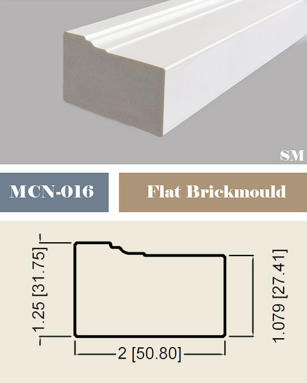
A frame set reaches better yield when the trim pieces support the same production logic. Flat Brickmould gives door plants a compatible exterior-trim option instead of forcing a separate material decision late in the program. When the jamb, Flat Brickmould, and matching threshold strip are planned together, operators spend less time reconciling mismatched edges, finishes, or installation assumptions.
This coordination is practical rather than decorative. Flat Brickmould belongs in the same frame-package check because trim fit can protect line rhythm or create another adjustment at the end of assembly.
Door plants should check the profile family, jamb depth, exterior trim, threshold relationship, and machining drawing before bulk production starts. When Flat Brickmould is confirmed early, the review stays short but protects the line from repeated small corrections.
The most useful pre-run checks are simple:
- Confirm the finished jamb depth against the target market and wall construction.
- Match the Flat Brickmould profile and threshold strip to the exterior frame detail.
- Validate CNC cut, routing, and engraving data on the actual profile.
- Check surface hardness and fastening requirements before the first batch.
The Practical Takeaway
PVC profiles improve pre-hung door yield by making the starting material more predictable. They reduce time spent sorting, trimming, correcting, and rechecking parts that should have moved cleanly through the line. The strongest result comes when material consistency is paired with the right jamb depth, compatible trim, sound machining data, and batch-level quality control.
If a pre-hung program is losing time to frame variation, share the target market, jamb size, drawing, and machining plan so we can discuss the profile set around the exact yield problem on your line. Our role as a PVC door frame manufacturer is to help keep the selected profile, machining plan, and trim package aligned before production begins.
FAQ
Does PVC automatically improve pre-hung door yield?
PVC helps most when the profile, fixtures, tooling, and drawings are matched before production. A prehung exterior door with PVC frame still needs controlled cutting, machining, and assembly checks, but the material gives the plant a more consistent input.
Which PVC jamb sizes are most relevant for North America?
Many U.S. door programs use 4-9/16-inch jambs, while many Canadian programs use 6-9/16-inch jambs. The final choice should follow the actual wall build-up, door-system drawing, and market requirement.
Can PVC profiles be processed on automated equipment?
Yes. Xinhong New Materials PVC profiles can be processed with automatic CNC door-frame engraving and cutting machines, which supports repeatable cuts and machining details in pre-hung production. The selected PVC door frame extrusion line should still be matched to the profile geometry and required operations.
What quality points should a door plant confirm first?
A door plant should confirm profile dimensions, surface condition, jamb depth, machining data, fastening behavior, and compatible brickmould or threshold details before moving into a high-volume batch.

Produits
Produits associés
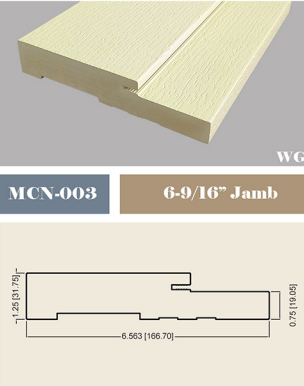
Le chambranle MCN-003 est un profilé de chambranle de porte de 16,7 cm (6-9/16 po) conçu pour couvrir toute la profondeur des ouvertures de portes et de fenêtres, assurant une protection complète du bord du vantail jusqu'à la surface extérieure du mur. Il offre une base de fixation stable pour le vantail tout en créant un bord net et précis pour l'ouverture. Particulièrement adapté aux murs épais ou aux systèmes de cadres de portes à isolation extérieure.
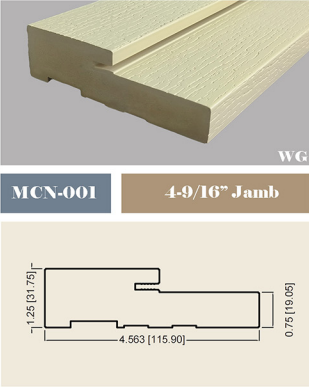
Le chambranle MCN-001 est un profilé de chambranle de porte de 116 mm (4-9/16 po) conçu pour couvrir toute la profondeur des ouvertures de portes et de fenêtres, assurant une protection complète du bord du vantail jusqu'à la surface extérieure du mur. Il offre une base de fixation stable pour le vantail et une finition nette du bord de l'ouverture. Convient aux systèmes de cadres de portes murales standard dans les bâtiments résidentiels et commerciaux.
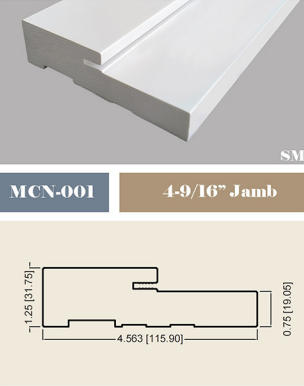
Le chambranle MCN-001 est un profilé de chambranle de porte de 116 mm (4-9/16 po) conçu pour couvrir toute la profondeur des ouvertures de portes et de fenêtres, assurant une protection complète du bord du vantail jusqu'à la surface extérieure du mur. Il offre une base de fixation stable pour le vantail et une finition nette du bord de l'ouverture. Convient aux systèmes de cadres de portes murales standard dans les bâtiments résidentiels et commerciaux.
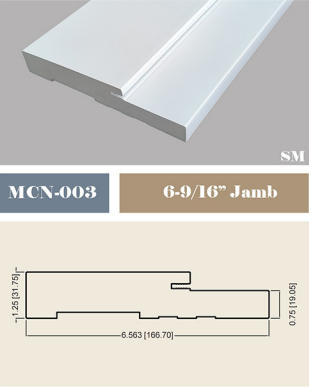
Le chambranle MCN-003 est un profilé de chambranle de porte de 16,7 cm (6-9/16 po) conçu pour couvrir toute la profondeur des ouvertures de portes et de fenêtres, assurant une protection complète du bord du vantail jusqu'à la surface extérieure du mur. Il offre une base de fixation stable pour le vantail tout en créant un bord net et précis pour l'ouverture. Particulièrement adapté aux murs épais ou aux systèmes de cadres de portes à isolation extérieure.
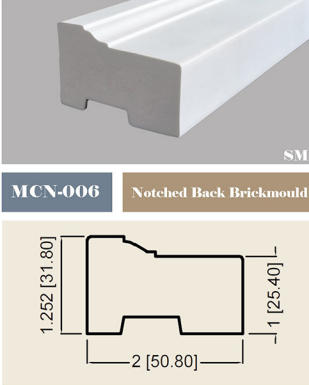
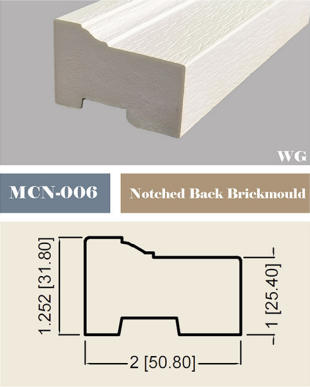
Le profilé de brique à encoche arrière MCN-006 est une moulure extérieure haut de gamme conçue pour les encadrements de portes et de fenêtres. L'encoche à l'arrière permet un ajustement précis aux briques, au crépi ou au bardage. Les profilés de brique de la série WG ont été affinés pour s'adapter à différentes épaisseurs de murs et à diverses applications.
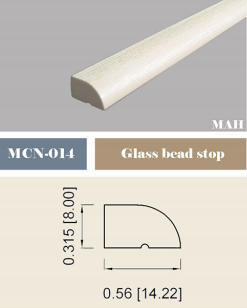
Le joint d'arrêt en verre MCN-014 est un composant de vitrage de conception professionnelle utilisé pour fixer, positionner et sceller les panneaux de verre des portes et fenêtres. Il s'installe entre le verre et le cadre pour empêcher tout mouvement du verre et offre une finition décorative impeccable. Convient aux systèmes de portes et fenêtres résidentiels et commerciaux.
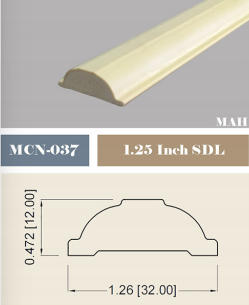
Le MCN-037 SDL est une baguette décorative de 3,2 cm (1,25 pouce) imitant les petits carreaux, conçue pour être appliquée directement sur les surfaces vitrées et reproduisant l'aspect des véritables fenêtres à petits carreaux traditionnelles. Elle permet d'obtenir l'esthétique classique d'une fenêtre à plusieurs carreaux sans remplacer l'ensemble de la structure. Son profil épuré s'harmonise avec une grande variété de styles architecturaux.
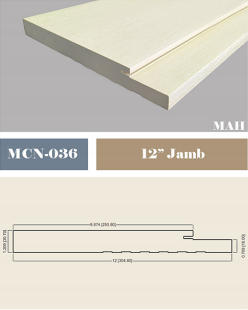
Le chambranle MCN-036 de 30,5 cm (12 po) est un chambranle extra-large conçu pour les murs épais ou les ouvertures de portes/fenêtres profondes. Son profil large couvre toute la distance entre le bord du vantail et la surface extérieure du mur, assurant un support stable et une finition décorative soignée. Convient aux bâtiments résidentiels, commerciaux et industriels.
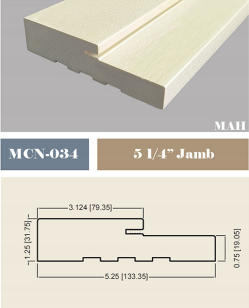
Le chambranle MCN-034 est un profilé de chambranle de porte de 13,3 cm (5-1/4 po) conçu pour couvrir toute la profondeur des ouvertures de portes et de fenêtres, assurant une protection complète du bord du vantail jusqu'à la surface extérieure du mur. Il offre une base de fixation stable pour le vantail tout en créant un bord net et précis pour l'ouverture. Convient aux systèmes de cadres de portes standard et à parois épaisses, dans les bâtiments résidentiels et commerciaux.
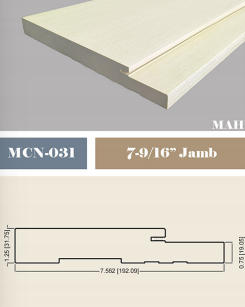
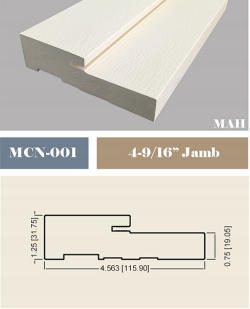
Le chambranle MCN-001 est un profilé de chambranle de porte de 116 mm (4-9/16 po) conçu pour couvrir toute la profondeur des ouvertures de portes et de fenêtres, assurant une protection complète du bord du vantail jusqu'à la surface extérieure du mur. Il offre une base de fixation stable pour le vantail et une finition nette du bord de l'ouverture. Convient aux systèmes de cadres de portes murales standard dans les bâtiments résidentiels et commerciaux.
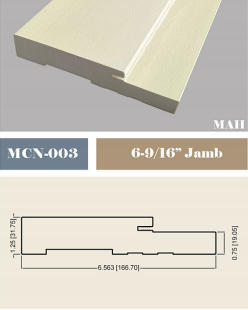
Le chambranle MCN-003 est un profilé de chambranle de porte de 16,7 cm (6-9/16 po) conçu pour couvrir toute la profondeur des ouvertures de portes et de fenêtres, assurant une protection complète du bord du vantail jusqu'à la surface extérieure du mur. Il offre une base de fixation stable pour le vantail tout en créant un bord net et précis pour l'ouverture. Particulièrement adapté aux murs épais ou aux systèmes de cadres de portes à isolation extérieure.
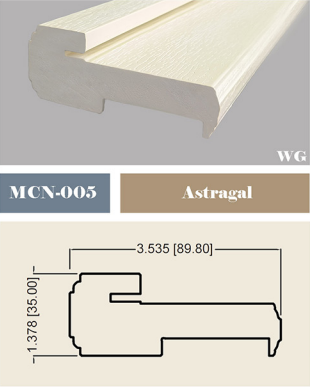
Ce joint d'étanchéité est un élément de finition professionnel conçu pour les portes doubles (portes-fenêtres). Il se fixe sur le chant du vantail inactif afin de masquer l'espace entre les deux vantaux, améliorant ainsi l'étanchéité à l'air, l'isolation phonique, l'intimité et offrant une finition esthétique.
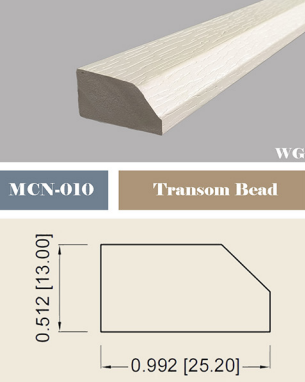
La baguette d'imposte MCN-010 est une moulure décorative de conception professionnelle pour les impostes (fenêtres fixes au-dessus des portes). Elle sert de bordure décorative, de maintien du vitrage ou de profilé de transition pour l'imposte. Son profil compact apporte une touche d'élégance aux ouvertures de portes dans les bâtiments résidentiels et commerciaux.
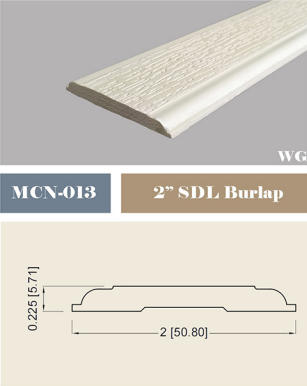
La frise décorative MCN-013 SDL Burlap, d'une largeur de 5 cm (2 pouces), imite les petits carreaux traditionnels et se pose directement sur le verre. Sa largeur de 5 cm (2 pouces) lui confère un aspect plus marqué et plus imposant. La finition en toile de jute lui donne une texture unique, rappelant le tissu, et ajoute une touche décorative naturelle et rustique.
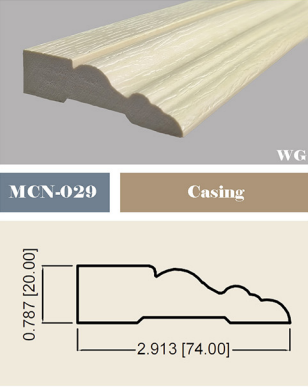
Le chambranle MCN-029 est une moulure de porte de conception professionnelle qui assure une transition décorative entre le cadre de la porte et le mur. Il masque l'espace entre le cadre et le mur, offrant une finition soignée et protégeant les bords du cadre de la porte. Convient aux ouvertures de portes intérieures dans les espaces résidentiels et commerciaux.
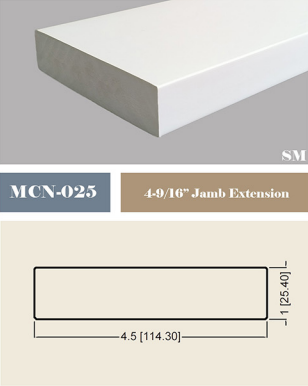
L'extension de chambranle MCN-025 est une rallonge de 116 mm (4-9/16 po) conçue pour augmenter la profondeur du chambranle standard des portes aux murs plus épais. Lorsque l'épaisseur du mur dépasse les dimensions standard du chambranle, l'extension se fixe parfaitement au bord du chambranle existant, assurant ainsi que le cadre soit aligné avec la surface du mur et offrant une base de montage complète et une finition impeccable.
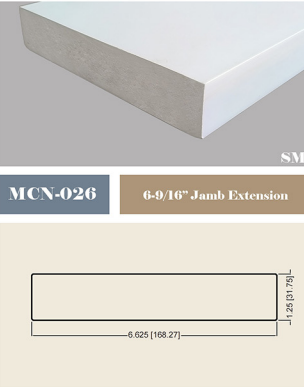
L'extension de chambranle MCN-026 est une rallonge de 16,7 cm (6-9/16 po) conçue pour augmenter la profondeur du chambranle standard des portes aux murs très épais. Lorsque l'épaisseur du mur dépasse les dimensions standard du chambranle, l'extension se fixe parfaitement au bord du chambranle existant, assurant ainsi un alignement parfait du cadre avec la surface du mur et offrant une base de montage complète et une finition impeccable.
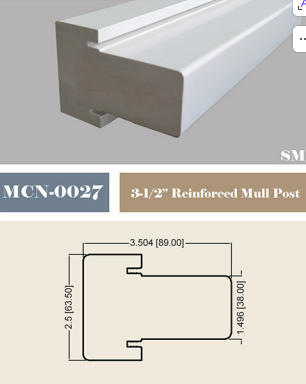
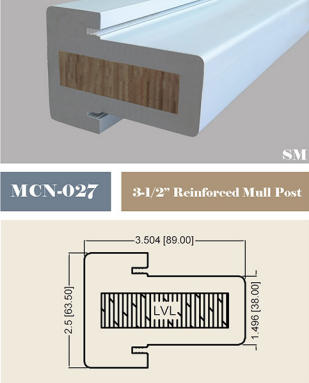
Le montant renforcé MCN-027 est un élément structurel vertical de 89 mm (3-1/2 po) conçu pour les systèmes combinés de portes et fenêtres. Il relie et fixe les éléments adjacents (fenêtres fixes, fenêtres ouvrantes, portes et impostes latérales, par exemple), offrant une résistance structurelle accrue pour une stabilité et une sécurité optimales des ouvertures. Le renforcement intégré en LVL (bois lamellé-collé) améliore considérablement sa capacité portante et sa résistance au gauchissement.
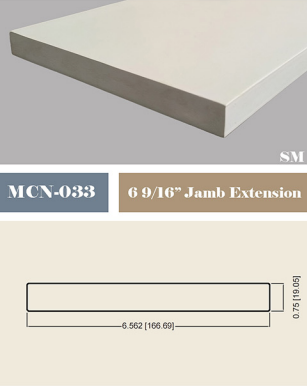
L'extension de chambranle MCN-033 est une rallonge de 16,7 cm (6-9/16 po) conçue pour augmenter la profondeur du chambranle standard des portes aux murs plus épais. Lorsque l'épaisseur du mur dépasse les dimensions standard du chambranle, l'extension se fixe parfaitement au bord du chambranle existant, assurant ainsi que le cadre soit aligné avec la surface du mur et offrant une base de montage complète et une finition impeccable.
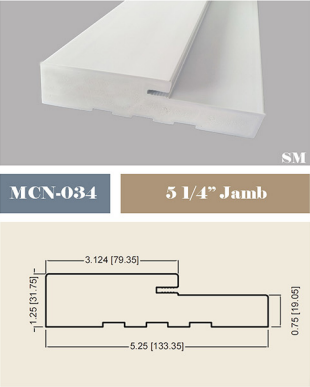
Le chambranle MCN-034 est un profilé de chambranle de porte de 13,3 cm (5-1/4 po) conçu pour couvrir toute la profondeur des ouvertures de portes et de fenêtres, assurant une protection complète du bord du vantail jusqu'à la surface extérieure du mur. Il offre une base de fixation stable pour le vantail et une finition nette du bord de l'ouverture. Convient aux systèmes de cadres de portes intérieures et extérieures des bâtiments résidentiels et commerciaux.
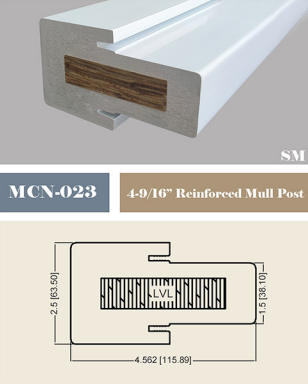
Le montant renforcé MCN-023 est un élément structurel vertical de 116 mm (4-9/16 po) conçu pour les systèmes combinés de portes et fenêtres. Il relie et fixe les éléments adjacents (fenêtres fixes, fenêtres ouvrantes, portes et impostes latérales, par exemple), offrant une résistance structurelle accrue pour une stabilité et une sécurité optimales des ouvertures. Le renforcement intégré en LVL (bois lamellé-collé) améliore considérablement sa capacité portante et sa résistance au gauchissement.
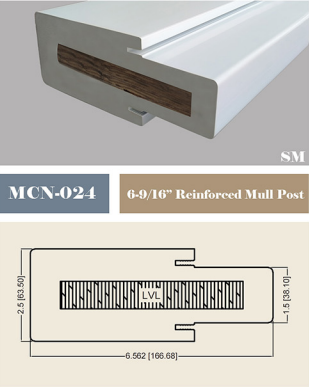
Le montant renforcé MCN-024 est un élément structurel vertical de 16,7 cm (6-9/16 po) conçu pour les systèmes combinés de portes et fenêtres. Il relie et fixe les éléments adjacents (fenêtres fixes, fenêtres ouvrantes, portes et impostes latérales, par exemple), offrant une résistance structurelle accrue pour garantir la stabilité et la sécurité des grandes ouvertures.
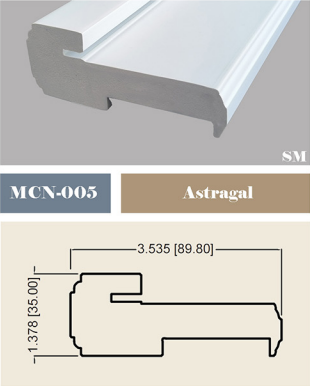
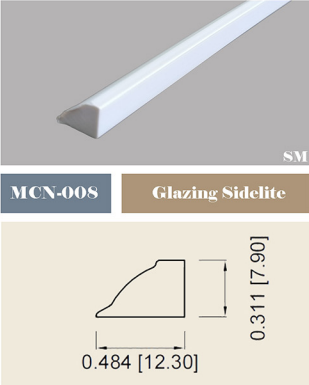
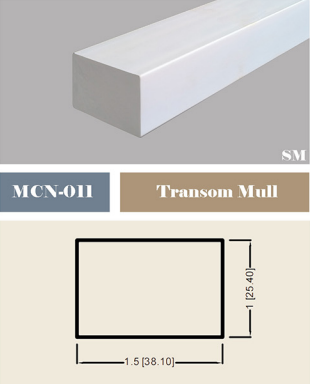
Le montant de traverse MCN-011 est un élément de charpente horizontal professionnel conçu pour séparer une porte de sa fenêtre de traverse (imposte latérale/fenêtre en éventail). Il assure le soutien structurel de la traverse tout en créant une ligne de séparation visuelle épurée, adaptée aux systèmes d'entrée des bâtiments résidentiels, commerciaux et publics.
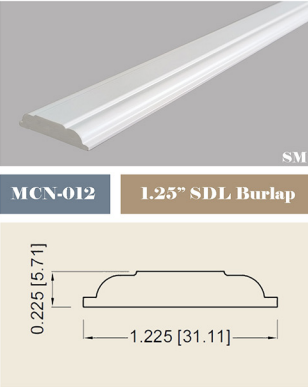
La baguette décorative MCN-012 SDL Burlap imite les petits carreaux traditionnels (SDL) et se pose directement sur le verre. Elle reproduit l'aspect des véritables fenêtres à petits carreaux classiques sans remplacer l'ensemble de la structure. Sa finition en toile de jute offre une texture unique, semblable à celle du tissu.
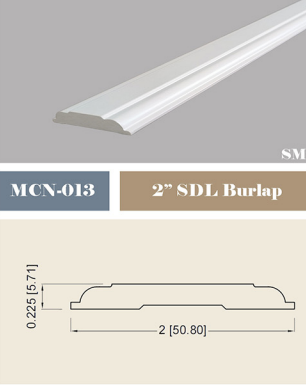
La baguette décorative MCN-013 SDL Burlap, d'une largeur de 5 cm (2 pouces), imite les petits carreaux traditionnels et se pose directement sur le verre. Plus large que les modèles plus étroits, elle offre un effet de croisillon plus marqué et plus imposant. Sa finition en toile de jute lui confère une texture unique, rappelant le tissu, et ajoute une touche rustique et naturelle.
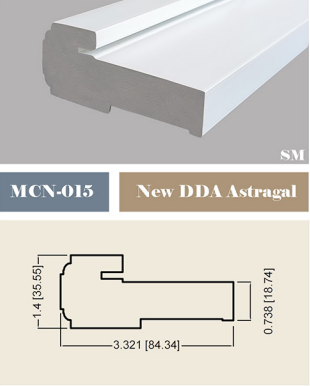
Le joint d'étanchéité MCN-015 New DDA est conçu pour répondre aux normes d'accessibilité des portes doubles (conformes à la loi américaine sur la discrimination des personnes handicapées / ADA). Il se fixe sur le chant du vantail inactif, assurant ainsi l'étanchéité entre les deux vantaux et garantissant le respect des exigences d'accessibilité, notamment en matière de force d'ouverture et de largeur d'espace.
Tel:
+86 18858129513